
ABSOLUTE HOME DESIGN · WALL DECOR & ART Should Wall Art Match the Rug? How to Coordinate Colors, Patterns & Room Style Use the rug you already own to choose artwork with a clear connection—and enough character of its own. Affiliate disclosure: This article contains affiliate links. If you buy through them, we may earn a commission at no extra cost to you. As an Amazon Associate I earn from qualifying purchases. You like the rug. It works with the sofa, the room feels comfortable, and now the empty wall is the part you cannot settle. Should the artwork repeat the rug’s colors? Is another pattern too much? Would something completely different look out of place? The short answer Wall art does not need to match the rug exactly. It can connect through a small shared color, compatible undertones, a similar mood or deliberate contrast. Consider the sofa, walls and flooring too: the rug is part of the room, not the only reference. Repeating every color in the same proportions c...
Absolute Home Design · Small-Space Coffee Bar
Best Compact Espresso Machines for Small Spaces: What Will Actually Fit Your Coffee Bar?
A compact espresso machine can fit on your counter and still make the coffee bar difficult to use. The better buying question is not simply “Which machine is smallest?” It is “Which setup fits the space and still lets me make coffee comfortably?”

Stored footprint ≠ operating footprint
Product dimensions tell you how much physical space the machine body occupies. Your coffee bar also has to support filling, preparing, brewing, steaming or finishing the drink, and cleaning afterward.
Measure the coffee bar before you compare machines
Start with the usable surface—not the advertised size of a machine. Measure the actual width, depth and vertical space available where the coffee station will live. Then look at what must happen around the appliance.
WIDTH
What must sit beside the machine? A grinder, milk pitcher, capsule storage,
cups or preparation tools can turn a narrow machine into a wide setup.
DEPTH
A machine can fit between the wall and counter edge but still leave too
little usable surface in front of it.
HEIGHT
Measure beneath shelves and upper cabinets, then check how the water tank,
bean hopper or lid is actually accessed.
Think through the complete sequence: STORE → FILL → PREPARE → BREW → STEAM → CLEAN. If the layout breaks at one of those stages, the machine does not really fit your coffee bar—even if its body fits on the counter.

Which space problem do you actually have?
1. WIDTH
Too little side-to-side space
2. DEPTH
Shallow counter or furniture
3. TOTAL SPACE
The whole system is too large
4. HEIGHT
Cabinet or shelf above
5. WORKFLOW
Too many separate steps or items
These are different constraints, so they should not automatically lead to the same machine. A very narrow machine can still be deep. A small espresso machine can still require a separate grinder. A capsule machine can simplify the workflow but changes the kind of coffee routine you are building.
1. If width is your problem
Narrow counters, carts and small niches make width immediately visible. But do not confuse narrow with small overall. Check depth and operating access before choosing a machine simply because its front profile looks slim.
Design principle:
protect some usable surface beside the machine instead of filling every
available inch with equipment.
UNITED STATES
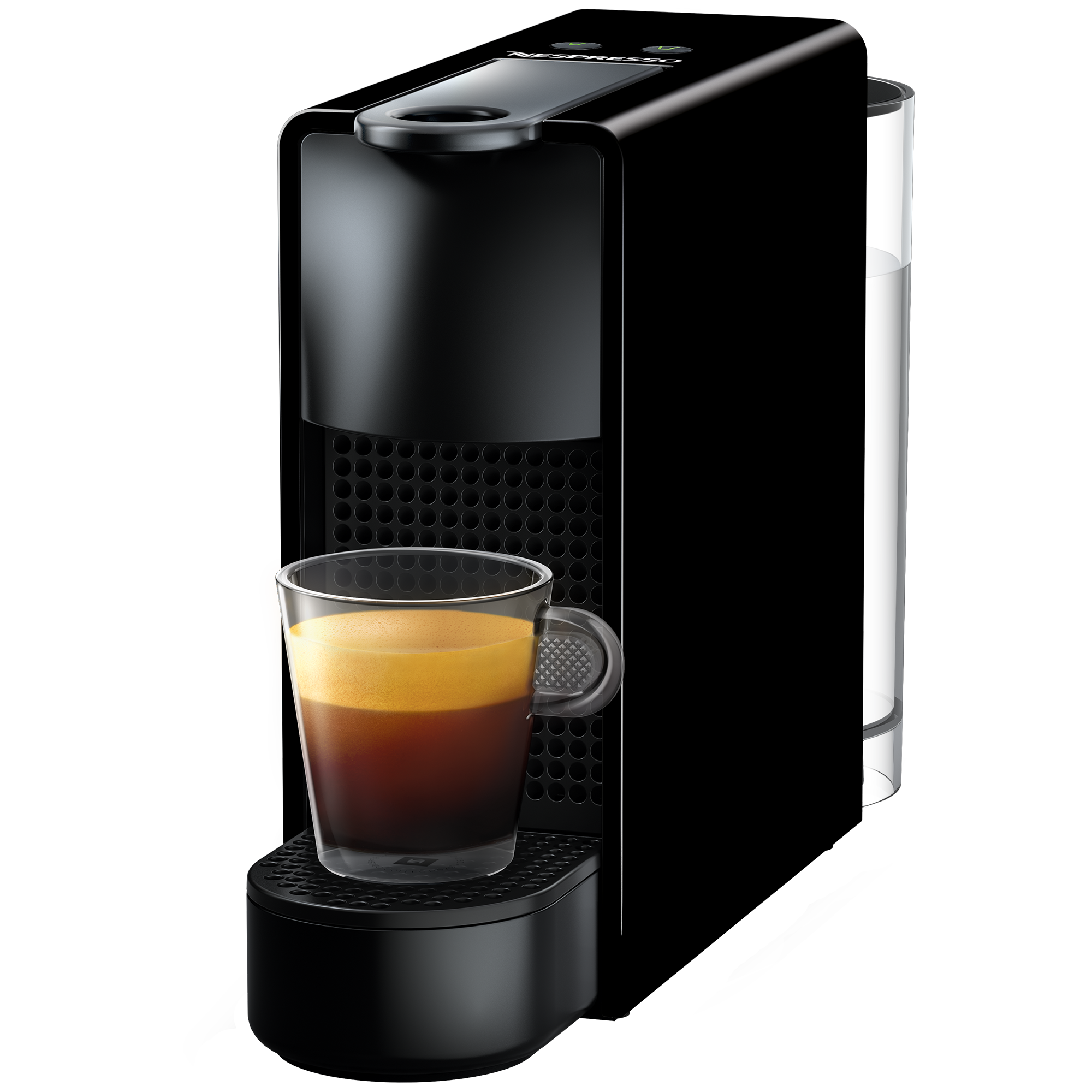
Nespresso Essenza Mini C30
Best fit here: extremely limited width + simple workflow
The Essenza Mini is the most space-focused option in this guide when the priority is a very small machine and a straightforward capsule routine. It removes the separate grinder, portafilter and tamping workflow required by traditional espresso.
US manufacturer dimensions:
3.3 × 12.8 × 8 in.
Water tank: 20.3 oz.
Used-capsule container: 6 capsules.
Water tank: 20.3 oz.
Used-capsule container: 6 capsules.
Source: Nespresso USA — Essenza Mini C30
Affiliate disclosure:
the Amazon button below is an affiliate link. Absolute Home Design may
earn a commission from qualifying purchases, at no additional cost to you.
Check Nespresso Essenza Mini on Amazon US

HiBREW H10A
Best fit here: compact traditional espresso setup
The H10A gives you a traditional semi-automatic espresso workflow in a relatively compact body. It uses a 58 mm portafilter and includes a steam wand, so remember that the machine itself is only one part of the setup: whole-bean users still need grinder and preparation space.
Manufacturer-listed product size:
10.3 × 9 × 12.6 in.
Water tank: 60 oz.
Portafilter: 58 mm.
Water tank: 60 oz.
Portafilter: 58 mm.
Source: HiBREW USA — H10A
Affiliate disclosure:
the HiBREW button below is an affiliate link. Absolute Home Design may
earn a commission if you purchase through it, at no additional cost to you.
See HiBREW H10A
We are not including the De’Longhi Dedica Arte EC885M in the US recommendations in this version of the guide. The purpose of the shortlist is to solve the reader's space problem rather than fill a product quota.
2. If depth is your problem
A sideboard, console or shallow cabinet creates a different problem. You may have enough width for a machine and grinder but very little front-to-back surface. This is where reading dimensions in the correct order matters.
UNITED STATES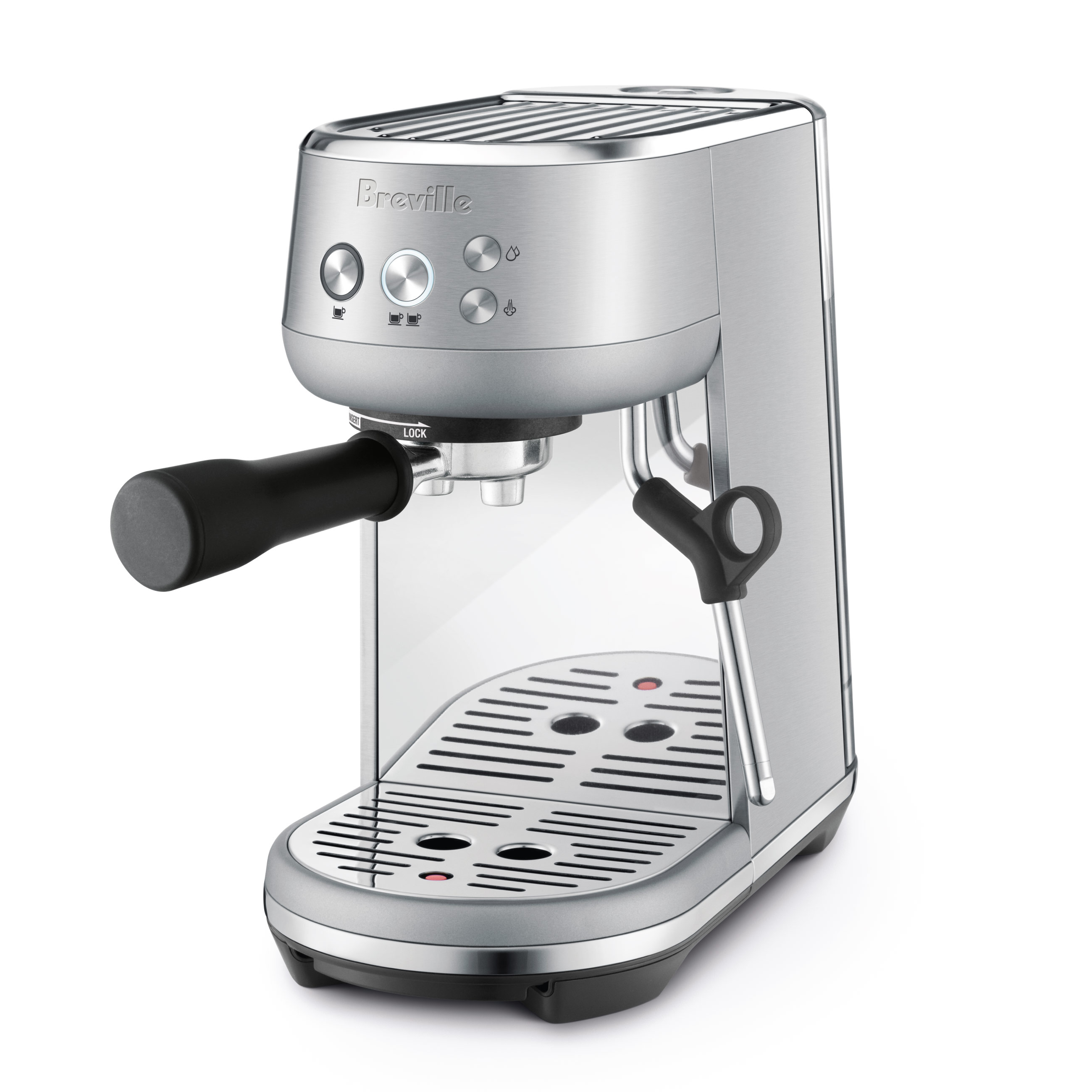
Breville Bambino BES450
Best fit here: shallow machine body + hands-on espresso
The Bambino is particularly interesting when front-to-back space is the constraint. It remains a traditional espresso machine, so the complete setup may still include a grinder, tamper, milk jug and preparation area.
Manufacturer dimensions (W × D × H):
11.9 × 6.1 × 13.5 in.
Source: Breville — Bambino BES450
Affiliate disclosure:
the Amazon button below is an affiliate link. Absolute Home Design may
earn a commission from qualifying purchases, at no additional cost to you.
Check Breville Bambino on Amazon US

xBloom Studio
Alternative path: integrated specialty pour-over system
xBloom Studio is not an espresso machine. It belongs in this guide because a small coffee bar can sometimes work better when the brewing architecture changes. Studio combines grinding and automated pour-over brewing in one appliance.
Manufacturer dimensions (L × W × H):
170 × 204 × 426 mm / 6.7 × 8 × 16.8 in.
Water tank: 946 ml / 32 oz.
Integrated grinder: 48 mm conical burrs.
Water tank: 946 ml / 32 oz.
Integrated grinder: 48 mm conical burrs.
Source: xBloom — Studio specifications
Affiliate disclosure:
the xBloom button below is an affiliate link. Absolute Home Design may
earn a commission if you purchase through it, at no additional cost to you.
Explore xBloom Studio — US

3. If the machine fits but the whole setup doesn’t
This is the hidden-footprint problem. A traditional espresso machine may require a grinder, dosing and tamping tools, a milk pitcher, somewhere for grounds or a knock box, cups and a surface on which to actually prepare the drink.
That does not make traditional espresso a bad choice. It means that you should compare systems rather than isolated appliances.
Empty counter is functional space.
You do not need to fill every inch with organizers or accessories.
An intentionally empty section can be where you dose, tamp, pour milk,
set down a cup and wipe the station clean.
4. If cabinets or shelves limit height
Do not stop at the listed machine height. A more useful calculation is:
Available vertical space − machine height = remaining vertical clearance
Then check the manufacturer’s instructions and physical design to see what needs to open, lift or be removed above the machine. There is no single universal clearance number that applies to every coffee maker.
Breville lists the Bambino at 13.5 in high. xBloom lists Studio at 16.8 in high. Those figures describe the appliances themselves; they do not establish how much clearance your particular cabinet arrangement needs for comfortable refilling and maintenance.
5. If you have no room for a complicated workflow
At this point the decision is less about one dimension and more about the number of objects and actions the coffee bar must support.
Traditional espresso
Choose this path when the espresso-making process itself matters to you. A Bambino or H10A can keep the machine body compact, but whole-bean espresso normally adds a separate grinder and preparation tools.
Capsule espresso
Choose this path when speed, simplicity and a small equipment footprint matter more than a hands-on barista workflow. The Essenza Mini removes grinding and tamping from the routine, although capsules still need storage.
Integrated specialty pour-over
xBloom Studio is a different category. It integrates grinding with automated pour-over brewing, so it can consolidate a specialty-coffee routine. The trade-off is a taller appliance and a different style of coffee—not espresso.

Compact coffee-machine options for UK small spaces
The same spatial test applies in the UK, but product naming, electrical requirements and available SKUs can differ. Do not assume that a US listing represents the UK version.
UNITED KINGDOM
Sage Bambino BES450
Best fit: compact traditional espresso where depth matters
The UK Bambino is sold under the Sage brand. It provides a compact espresso-machine body while retaining a portafilter and manual milk-steaming workflow.
Manufacturer dimensions (W × D × H):
30.2 × 15.4 × 34.2 cm.
Source: Sage — Bambino BES450
Affiliate disclosure:
the Amazon UK button below is an affiliate link. Absolute Home Design
may earn a commission from qualifying purchases, at no additional cost to you.
Check Sage Bambino on Amazon UK
De’Longhi Dedica Style EC685
Best fit: narrow UK coffee-bar layouts
The Dedica Style is useful when side-to-side width is the dominant constraint. Its slim body does not eliminate the need to check depth, portafilter movement, milk preparation and grinder space.
Manufacturer dimensions:
149 × 330 × 305 mm.
Water tank: approximately 1.1 L.
Water tank: approximately 1.1 L.
Source: De’Longhi UK — Dedica range
Affiliate disclosure:
the Amazon UK button below is an affiliate link. Absolute Home Design
may earn a commission from qualifying purchases, at no additional cost to you.
Check De’Longhi Dedica Style on Amazon UK
Nespresso Essenza Mini C30
Best fit: very small footprint + simple daily routine
For a reader who does not want grinder, tamping and steaming equipment taking over a small coffee station, the C30 provides a much simpler equipment path.
Nespresso C30 dimensions (W × D × H):
8.4 × 20.4 × 33 cm.
Water tank: 0.6 L.
Used-capsule container: 6 capsules.
Water tank: 0.6 L.
Used-capsule container: 6 capsules.
Source: Nespresso UK — Essenza Mini C30
Affiliate disclosure:
the Amazon UK button below is an affiliate link. Absolute Home Design
may earn a commission from qualifying purchases, at no additional cost to you.
Check Nespresso Essenza Mini on Amazon UK
xBloom Studio — UK/EU Store
Alternative specialty-coffee path — verify electrical compatibility
Studio remains relevant to the space-planning comparison because it combines grinding and automated pour-over brewing. It is not an espresso machine.
Manufacturer dimensions (L × W × H):
170 × 204 × 426 mm / 6.7 × 8 × 16.8 in.
Water tank: 946 ml / 32 oz.
Integrated grinder: 48 mm conical burrs.
Water tank: 946 ml / 32 oz.
Integrated grinder: 48 mm conical burrs.
UK buyers:
verify the exact voltage, plug and regional version directly with xBloom
before purchasing. Do not assume that a product displayed through the
European storefront is automatically compatible with a UK electrical supply.
Source: xBloom Europe — Studio
Affiliate disclosure:
the xBloom button below is an affiliate link. Absolute Home Design may
earn a commission if you purchase through it, at no additional cost to you.
View xBloom Studio — UK/EU Store
Which machine architecture fits your constraint?
| Your main constraint | Look at first | Remember |
|---|---|---|
| Very little width | Essenza Mini; Dedica Style in the UK | Narrow does not automatically mean shallow. |
| Shallow surface | Breville/Sage Bambino | Protect usable surface and check the complete workflow. |
| Want traditional espresso | Bambino/Sage Bambino or HiBREW H10A | A separate grinder changes the total footprint. |
| Want the simplest workflow | Nespresso Essenza Mini | Capsule storage still needs a home. |
| Want grinder + specialty brewing consolidated | xBloom Studio | It is pour-over, not espresso; check height and regional voltage. |
| Low upper cabinet | Compare the actual machine height individually | Also check tank, lid, hopper and maintenance access. |
The final fit test before you buy
- STORE: Where will beans, grounds, pods, cups and tools live?
- FILL: Can you reach and remove or refill the water tank comfortably?
- PREPARE: Is there usable surface for the steps your brewing method requires?
- BREW: Can the portafilter, cup, controls and moving parts be used without hitting surrounding objects?
- STEAM: If the machine steams milk, can the wand and pitcher actually be used in the planned position?
- CLEAN: Can you remove the drip tray, dispose of grounds or capsules and wipe the area without dismantling the coffee bar?
The buying rule
Don’t choose the smallest machine. Design the smallest coffee bar that still works beautifully.
The right product is the one whose complete routine fits your available space—not simply the one with the smallest number in a specification table.
Check the Whole Setup Before You Buy the Machine
You have compared width, depth, height and workflow. Now use the free AHD Small-Space Coffee Bar Planner to put your own measurements, equipment and routine on one plan and make sure the complete coffee bar works before you commit to a purchase.
Free Planner + practical follow-up emails to help you diagnose space constraints, prioritize the setup and choose equipment that actually fits. Unsubscribe anytime.
Still planning the coffee bar itself?
Before choosing equipment, see our broader Home Coffee Bar Ideas guide for location, furniture, storage, organization and layout ideas.
Want to turn the decisions into a complete coffee-bar plan?
The Absolute Home Design Coffee Bar Design & Setup System takes you beyond inspiration and helps you work through the complete setup: space, equipment, storage, workflow and implementation.
60-page planning & implementation system · $19.99
Get the Coffee Bar Design & Setup System — $19.99
Comments
Post a Comment