
ABSOLUTE HOME DESIGN · WALL DECOR & ART Should Wall Art Match the Rug? How to Coordinate Colors, Patterns & Room Style Use the rug you already own to choose artwork with a clear connection—and enough character of its own. Affiliate disclosure: This article contains affiliate links. If you buy through them, we may earn a commission at no extra cost to you. As an Amazon Associate I earn from qualifying purchases. You like the rug. It works with the sofa, the room feels comfortable, and now the empty wall is the part you cannot settle. Should the artwork repeat the rug’s colors? Is another pattern too much? Would something completely different look out of place? The short answer Wall art does not need to match the rug exactly. It can connect through a small shared color, compatible undertones, a similar mood or deliberate contrast. Consider the sofa, walls and flooring too: the rug is part of the room, not the only reference. Repeating every color in the same proportions c...
Small-Room Planning · Furniture Decisions
Multifunctional Furniture for Small Spaces — How to Choose Pieces That Earn Their Footprint
In a small room, the question is not simply whether a piece of furniture fits. The better question is whether it does enough useful work to justify the floor area it permanently occupies.
That distinction changes how you shop for small-space furniture. A tiny table that performs one rarely needed job can be a worse use of space than a slightly larger piece that replaces two pieces, stores everyday items, changes function when needed, or adapts as the room changes.
This guide gives you a practical way to make that decision before you buy anything: the AHD Footprint Test.

The rule: every function has a space cost
Small-room planning is not about owning the fewest possible things. It is about making sure the space you give to furniture produces enough function, storage, comfort or adaptability in return.
Furniture can fit — and still be the problem
One of the easiest small-space mistakes to make is treating dimensions as the final decision. You measure the wall, find a sofa that fits it, find a coffee table that fits in front of it, squeeze in an ottoman, add a side table and conclude that the layout works because every object technically fits inside the room.
But furniture also consumes circulation space, visual space and operating space. Doors and drawers need to open. Chairs need room to pull out. A lift-top table needs clearance to rise. A transforming table may be compact most of the day but require considerably more space when it is being used.

The AHD Footprint Test
Before replacing furniture — or adding another supposedly “space-saving” piece — run it through these seven questions.
1
What essential job does it perform?
If you cannot clearly name the job, the piece may be occupying space
simply because furniture is normally placed there.
2
How often do you actually use that job?
Daily functions deserve more permanent floor area than functions you
use a few times a year.
3
Can it replace another piece?
A desk that becomes a dining table may eliminate the need for a
permanent second table.
4
Does it add useful storage?
Storage matters only when it stores things you actually need near that
location. Hidden space that becomes a junk drawer does not automatically
make furniture efficient.
5
Can it adapt when the room changes?
Modular or transformable furniture can earn extra value when those
configurations solve real situations in your life.
6
How much space does it require in every operating state?
Measure it closed, open, extended, pulled out and in use — not only in
its most compact marketing photo.
7
What circulation does it cost?
A multifunctional piece that blocks the room every time you use its
second function has not solved the planning problem.
AHD decision rule:
Do not count features. Count useful jobs. A piece with six advertised
features is not multifunctional for your room if you only need
one of them.
1. Look for more value from the same footprint
The clearest form of multifunctionality is a piece that occupies roughly the same everyday floor area while giving you additional functions when you need them.
A lift-top coffee table is a good example. In ordinary use it is still a coffee table. But the lifting surface can create a more comfortable height for a laptop or casual meal, while the body of the table may also provide concealed storage.

But do not buy a lift-top table merely because it lifts. Ask whether you genuinely need the higher work or eating surface and whether the storage solves a real need. If neither does, a simpler table may be the more efficient choice.
WLIVE
Lift-top coffee table example · Amazon US
Lift · Work · Store

One footprint.
Raised work surface + concealed storage.
Footprint lesson: added function
Compare lift-top coffee tables
Look for a table whose raised surface solves a real work or casual dining need, while hidden storage replaces storage you would otherwise need elsewhere.
Check the full dimensions with the top raised before buying. The best option is not automatically the table with the most compartments; it is the one whose extra functions match your routine.
Compare Lift-Top Coffee Tables on Amazon US
Affiliate disclosure — Amazon:
As an Amazon Associate, Absolute Home Design may earn from qualifying
purchases made through this link, at no additional cost to you.
YAHEETECH
Lift-Up Coffee Table · Amazon UK
Lift-top solution

Raised surface + hidden compartment + lower shelf.
Specific product example
Yaheetech Lift-Up Coffee Table
Its lift-top creates a raised work or casual dining surface, while the table also provides hidden storage and a lower open shelf.
Treat those functions as benefits only if you genuinely need them. Confirm current dimensions, availability, finish and price before ordering.
View the Yaheetech Table on Amazon UK
Affiliate disclosure — Amazon:
As an Amazon Associate, Absolute Home Design may earn from qualifying
purchases made through this link, at no additional cost to you.
2. Adaptability can matter more than simply buying smaller furniture
“Small-space furniture” is often treated as if smaller is always better. It is not.
One adequately sized modular sofa may perform better than several separate seats if it gives the household the seating it genuinely needs while adapting to different layouts.

Do not ask:
“Is this sofa small?”
Ask: “Does this sofa give me the seating and adaptability I need without forcing me to add more permanent pieces?”
Ask: “Does this sofa give me the seating and adaptability I need without forcing me to add more permanent pieces?”
MONVANE
Modular sofa collection
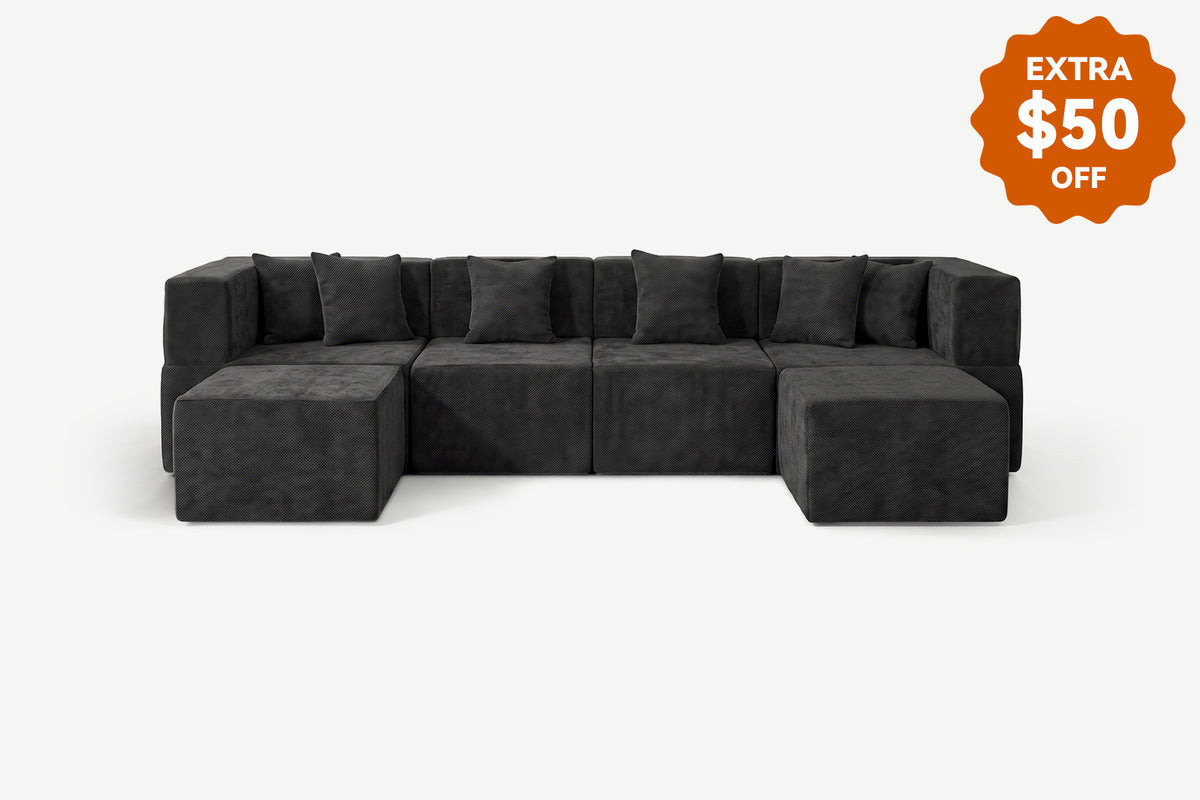 U-Shaped Layout
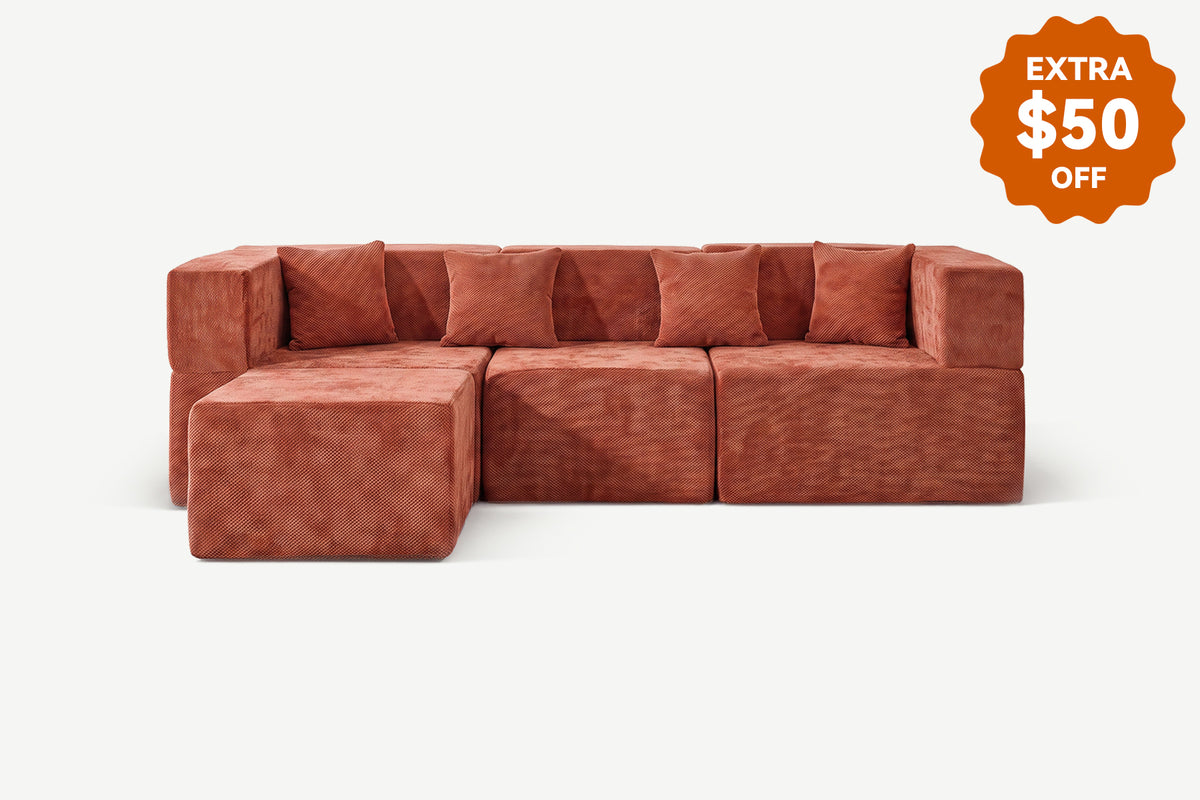 L-Shaped Layout
 Compact Layout
Compare the Footprint
Different layouts can serve the same room very differently.
Footprint lesson: adaptability
Explore MONVANE modular configurations
We are linking to the modular collection rather than prescribing one sofa size. The correct configuration depends on your usable floor area, seating requirement and circulation.
Compare the layouts as a system. The useful question is not simply which sofa looks smaller, but which configuration delivers enough seating without forcing additional furniture into the room.
Explore MONVANE Modular Sofas
MONVANE COUPON
New customers can use code MONAFF10 for 10% off with no minimum spend. MONVANE states that this code can be combined with other spend-based discounts.
Alternative code: AFF5OFF for 5% off, with no minimum spend and no usage limit.
Affiliate disclosure — MONVANE:
The MONVANE link is an affiliate link. Absolute Home Design may earn
a commission at no additional cost to you.
3. Transformation works when the second state replaces a real piece of furniture
Transforming furniture is most valuable when its alternate state prevents you from needing another permanent piece.
A desk that becomes a dining table is a stronger small-space solution when you genuinely need both functions but do not need both operating at the same time.

EXPAND FURNITURE
Mini Flip · Compact Desk to Table
One Piece · Two Useful States

Everyday State · Desk / Console
→

Expanded State · Table
Footprint lesson: transformation
Mini Flip — Compact Desk to Table
The comparison shows why this product is relevant to the footprint test. The same permanent piece changes from a compact desk or console into a substantially larger work or dining surface.
The advantage matters only when you genuinely need both states and have enough clearance to use the expanded state comfortably.
See the Mini Flip at Expand Furniture
Affiliate disclosure — Expand Furniture:
This is an affiliate link. Absolute Home Design may earn a commission at
no additional cost to you.
4. Storage furniture only earns its footprint when the storage is useful
Hidden storage is one of the easiest features to overvalue. An ottoman with storage can be excellent in a small room because it may combine a footrest, occasional seat and storage volume. But it still has to occupy floor space.
Before buying one, decide what will live inside it. Blankets used on the sofa, toys used in the living room or equipment that otherwise needs a separate basket are logical candidates. Objects that belong elsewhere are not a reason to add another container to the room.
A storage ottoman earns its footprint when…
- you need a footrest anyway;
- it can provide occasional seating;
- its storage replaces another basket, box or small cabinet;
- it does not obstruct normal circulation.
It probably does not when…
- you are buying it mainly because it has storage;
- you already have enough seating and storage;
- it sits permanently in a walkway;
- its contents simply become miscellaneous clutter.
SONGMICS
Storage ottoman example · Amazon US
Store · Sit · Rest

The value comes from
consolidating jobs
,
not merely adding storage.
Footprint lesson: consolidation
Compare storage ottomans
The Amazon US link opens a broader selection rather than prescribing the pictured product.
Compare dimensions first, then determine whether an ottoman can replace storage, a footrest or occasional seating you would otherwise add separately.
Explore Storage Ottomans on Amazon US
Affiliate disclosure — Amazon:
As an Amazon Associate, Absolute Home Design may earn from qualifying
purchases made through this link, at no additional cost to you.
SONGMICS
Compact storage ottoman · Amazon UK
Compact multifunction

Useful when one compact piece can replace
both storage and another small furnishing.
Footprint lesson: compact multifunction
Compare compact storage ottomans
Concentrate on outside dimensions and the jobs the ottoman will actually perform.
A compact storage ottoman can make sense when it replaces a separate footstool or storage basket without narrowing the main route through the room.
Explore Compact Storage Ottomans on Amazon UK
Affiliate disclosure — Amazon:
As an Amazon Associate, Absolute Home Design may earn from qualifying
purchases made through this link, at no additional cost to you.
Before you replace anything, measure the furniture you already own
Multifunctional furniture is not automatically an upgrade. Sometimes the best decision is to keep what you have, remove an unnecessary second piece, or change the layout.

Measure the existing piece and write down every job it performs. Then measure the alternative in both its compact and operating states. Finally, draw the circulation route around it.
Only after those checks should you ask whether the replacement earns its footprint better.
The replacement test
A new piece should solve a problem your existing furniture does not solve. “It is multifunctional” is not enough. The additional function has to remove another space cost, improve a routine, add useful storage or make the room meaningfully more adaptable.
How to choose multifunctional furniture without overcrowding the room
When comparing products, use this order:
- Define the missing function. Start with the room problem, not the product category.
- Measure the usable footprint. Exclude doors, circulation and other required clearances.
- Measure the operating footprint. Include extensions, open lids, chairs and moving parts.
- Count useful jobs. Ignore functions you will not use.
- Ask what it replaces. Strong multifunctional furniture removes another space cost.
- Test the transition. The second function must be convenient enough to use.
- Make sure the room still works in every state.
The bottom line
Small-space furniture does not have to be miniature, and multifunctional furniture does not need to perform as many jobs as possible.
Give permanent floor space only to furniture that returns enough useful value for the space it consumes.
Sometimes that means a modular sofa. Sometimes it means a desk that becomes a table, a lift-top coffee table or a storage ottoman. Sometimes the correct answer is not to buy another piece at all.
Run every candidate through the AHD Footprint Test, measure every operating state, protect circulation, and let the way you actually live decide which functions deserve space.
Frequently asked questions
What is the best multifunctional furniture for a small living room?
There is no single best type. Start with the function your room is missing. A lift-top coffee table can make sense when you need a raised laptop or casual dining surface; modular seating can make sense when you need adaptable seating; a storage ottoman can make sense when it replaces both a footrest and separate storage.
Is multifunctional furniture always better for small spaces?
No. The additional functions must be genuinely useful and practical to operate. Otherwise the extra mechanisms or size may provide little real benefit.
Should I buy smaller furniture for a small room?
Not automatically. A larger piece that consolidates several real needs can sometimes use space more efficiently than several smaller independent pieces.
How do I know whether furniture is too big for my room?
Check the complete footprint, operating clearance and everyday circulation, not only the wall measurement.
Is storage furniture always good for small spaces?
No. Storage is valuable when it replaces another storage requirement rather than merely creating another place for clutter.
Product specifications and availability can change. Always verify current dimensions, configuration, operating clearance, price, delivery terms and return conditions before purchasing.
Comments
Post a Comment